

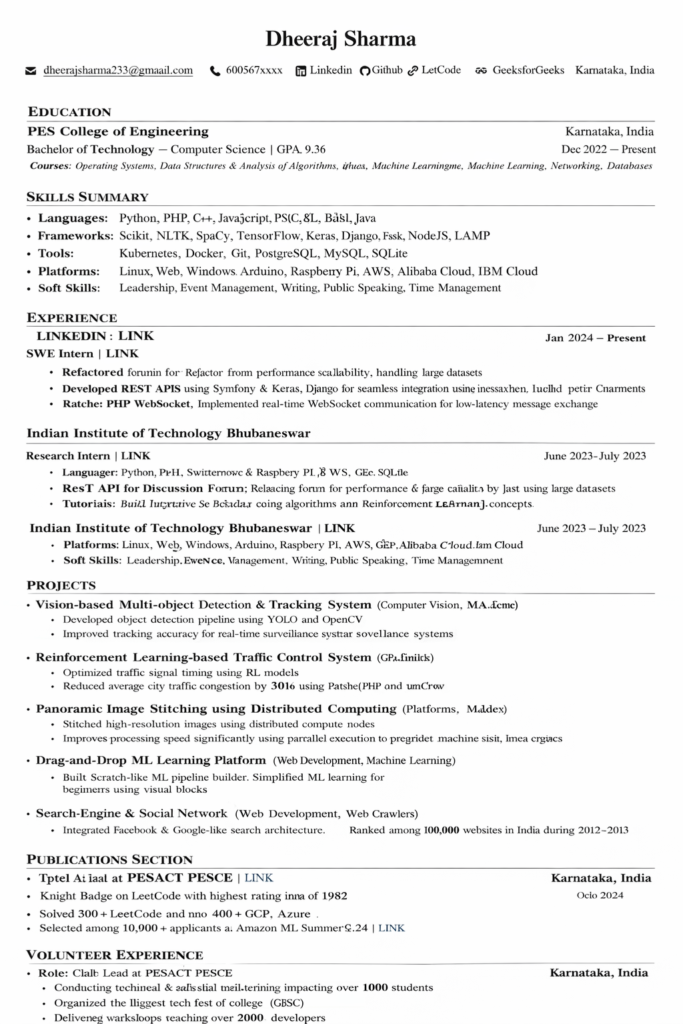
A resume shown in the image is presented as one that “got into Google.”
When closely analyzed, the resume reveals a very specific pattern.
It is not visually impressive, not colorful, and not creative in design.
Its strength lies entirely in structure, clarity, and technical depth.
This section explains how to create a resume using exactly the same structure and content logic seen in that proven resume.
1. Start With a Clean, Text-Only Header
The resume begins with the candidate’s full name at the top center, followed by a single line of essential details.
What is included:
- Email address
- Phone number
- GitHub
- LeetCode
- GeeksforGeeks
- Location
What is not included:
- Profile photo
- Icons
- Extra formatting
This shows that the resume is designed for ATS systems and recruiter scanning, not visual attraction.
2. Education Comes First and Is Clearly Structured
The education section appears immediately after the header.
It includes:
- College name
- Degree name
- Branch
- GPA
- Location
- Duration
- Relevant coursework
Courses are listed directly under education instead of being hidden elsewhere.
This tells recruiters what foundational knowledge the candidate has without over-explaining.
The education section is short, factual, and measurable.
3. Skills Are Grouped, Not Mixed
The skills section is titled “Skills Summary” and is divided into clear categories.
The resume separates:
- Programming languages
- Frameworks
- Tools
- Platforms
- Soft skills
Each category contains only related items.
There is no random skill dumping.
This structure helps:
- ATS keyword matching
- Fast human scanning
- Clear understanding of technical breadth
4. Experience Focuses on Work, Not Titles
The experience section includes internships, not full-time roles.
Despite that, the descriptions are written like professional engineering work.
Each role includes:
- Company or institution name
- Role title
- Time period
- Technical work performed
The bullet points describe:
- Systems worked on
- Technologies used
- Type of problems solved
There is no personal language and no exaggeration.
The focus stays strictly on technical contribution.
5. Projects Are Treated as Core Proof, Not Extras
The projects section is long and detailed, showing that projects are a central part of the resume.
Each project clearly indicates:
- Problem domain
- Technical area (AI, ML, Web, Distributed Systems)
- Tools and technologies used
Projects include:
- Computer vision systems
- Reinforcement learning applications
- Distributed computing
- Web platforms
- Search systems
This shows depth across multiple technical areas, not just tutorials or basic apps.
6. Publications Are Included, Even as Work in Progress
The resume includes a separate Publications section.
It lists:
- Book titles
- Subject areas
- Technologies involved
- Status as work in progress
This signals long-term learning and technical writing ability.
Even unfinished work is documented professionally.
7. Honors and Awards Are Strictly Technical
The honors section includes:
- Industry recognition
- Coding platform achievements
- Competitive selections
There are no non-technical awards or unrelated certificates.
Every item strengthens the technical credibility of the candidate.
8. Volunteer Experience Is Written Like Leadership Experience
Volunteer work is presented with:
- Role
- Organization
- Duration
- Scale of impact
Numbers are used to show reach, such as:
- Number of students trained
- Number of developers reached
This section demonstrates leadership without emotional language.
9. The Entire Resume Uses One Consistent Format
Across the resume:
- Single column layout
- Serif font
- Bold section headers
- Bullet points
- No graphics
This ensures:
- ATS compatibility
- Clean parsing
- Professional readability
The green “CRACKED” stamp is not part of the resume itself but part of the Instagram post overlay.
What This Resume Teaches
From the image alone, the resume shows that cracking high-package Google roles is not about:
- Design creativity
- Visual styling
- Fancy templates
It is about:
- Clear structure
- Strong technical depth
- Organized information
- Evidence-based content
The resume is calm, dense with information, and focused entirely on engineering capability.
Final Observation From the Image
The resume does not try to impress emotionally.
It simply presents facts, skills, work, and impact in a format that Google can read, understand, and trust.
That is the exact pattern shown in the image—and that is the model to follow.